Showing posts with label Latest News. Show all posts

A Nobel Peace Prize and a one Massacre

On 16 July 2012, Aung Sang Suu Kyi, the Myanmar Opposition leader stood in front of a huge audience at the Oslo City hall in Norway. The wait was over for her and, it seemed, for Burma for she was to finally accept the Nobel Peace Prize that had been awarded to her 21 years ago. The moment of triumph was long overdue and victory had been gained after years of the despairing isolation of house arrest. As she spoke about how the prize had succeeded in dispelling the sense of isolation, Suu Kyi steered her speech towards the issue of war. She spoke of how the first world war had represented ‘a terrifying waste of youth and potential’ and how even today we cannot help but wonder what so many young men fighting in that battle really died for.

Are we not still guilty, if to a less violent degree, of recklessness, of improvidence with regard to our future and our humanity? War is not the only arena where peace is done to death. Wherever suffering is ignored, there will be the seeds of conflict, for suffering degrades and embitters and enrages.

Her words are certainly touching and fitting for a Nobel speech. But it seems that fate has a sense of irony and a rather cruel one too; today amidst the persecution of the Rohingya Muslims in Burma, Suu Kyii’s silence is speaking louder than any words she ever uttered. Up till now she has not criticized the Burmese president for questionable policies that are reflective of ethnic cleansing, and critics suggest she also sees the Muslim group as immigrants rather than citizens.

In Pakistan, the reaction appears to be mixed. True, there is growing resentment towards the Burmese government but there are also those who question if the massacre really is taking place or the reports are exaggerated and that the numbers of the victims are not high enough to provoke an outburst. Others also believe that it would be better if we were to pay attention to the problems of our own our own country. For the skeptics, let’s examine the facts; It is certainly true that the Burmese government has denied any violence any security forces against the community. However, what is also noteworthy is that since the riots began, the Burmese authorities have ordered all international NGOs out of the region. Scores of NGO workers staff have been arrested while others are missing.

According to a report by Amnesty International, the situation of ethnic minorities in Burma is grave and violence against the Rohingya community in the western state of Rakhine is on the rise.

These facts speak for themselves. But lets assume for a moments that the reports are exaggerated. Well, what then? Should we wait for the numbers to rise to a million before we protest about the unjust killings of innocent people? The thought seems cruel and harldy one I would like to put to words but then we gone down this road before, haven’t we? Don’t there exist, even today, people who staunchly maintain that the Jewish Holocaust never took place? That the numbers of holocaust victims were not as high as deemed to be? Once, and for all, it doesn’t matter, whether one person is killed or six billion! If they are killed just because they belong to a particular religion, cast, creed or colour, we need to rise up against whoever is committing such atrocities because anyone who can take away innocent lives out of hatred, no matter how many, is capable of just about anything.

As for the opinion that we might be better off worrying about atrocities being committed in our own country, yes, I certainly see where that is coming from. After all, aren’t we also guilty of silence while our borders bleed and thousand meet their deaths in the face of drone attacks? Maybe so, but the thing is, we cannot handpick and choose. There is always going to be a battle between the oppressed and oppressor. Wherever we see that kind of suffering, it is our duty and the rights of the victims that are voices be raised for them. Read about it, understand what is happening, write, talk to people and educate them about the need to spread the word of all the massacres taking place in the world today. Who knows, maybe these small acts may just be the step towards the end.


The history of the Rohingya people is extensive. Is Myanmar really their home? There is a score of literature on the net and books are being published by historians to answer this very same question. But is this really something we need to be focusing on? Does the world need a reminder about the longest war in history, one that is still going on today, namely the Israel-Palestine conflict? After over 60 years what has this questioning achieved? Nothing but the slaughter of innocents and the eviction of so many from the land they once called home. While we continue to bicker over this, we might as well be asking for another Palestine.

There was a time, centuries ago, during the golden period of their history, that the Rohingya people knew what it was like to live in peace. They have waited far too long for their golden age to begin again. Let’s not be embittered by our own divisions to forget their suffering. Because if we do, we are no better than someone who holds a trophy for a life-long struggle for human rights, only to grow silent over the anguished cries of a people waiting for justice to be served.

Eat Lean Meat and Lose Fat and Strong your health

High protein, low fat and low carbohydrate meals burn energy storage in human body more quickly than a low fat food. Such foods and diets lessen the need for caloric consumption and hunger. One can eat these foods to lose as much pounds as possible. There are several foods that fit the criteria.


Lean meat has been found, after numerous researches, to be one of the best in burning superfluous fats in the body. It not only provides necessary calories to body but also keeps dangerous things like cholesterol and fat in lower amounts in human blood.

The US Department of Agriculture And American Heart Association is working on the policy of encouraging people to eat lean meat instead of other meats. This naturally found lean meat includes chicken, fish from freshwater, shell fish, etc. Lean meat contains ingredients like fat, saturated fat and cholesterol according the recommendations of
FDA.

A game food or seafood package of 100 grams contains 10 gram total fat, 4.5 grams saturated fat and 95 milligram or less cholesterol. According to the Department of Agriculture And American Heart Association, food containing ingredients in this proportion is lean meat. Lean meat provides a lot many perks and may be taken to reduce
the risk of cardiac problems. The cholesterol quantity should be less than 300 milligram every day.

1. An egg contains 220 calories and 200 milligram cholesterol.
2. Half pound chicken breast contains 160 milligram cholesterol.
3. Half pound fat free turkey meat contains 440 calories.
4. Half pound fat free turkey crumbles contain 260 calories.
5. The proportion of vitamins and minerals is the same in lean meat as in the other ones.

Lean meat is available in different types like turkey breast, skinless and boneless chicken, fresh water fish, shell fish, ground beef (prepared according to the above criteria), and so on.

Thus, low fat lean meat has a number of advantages and one may use it by baking, roasting, broiling and grilling. It should not be cooked or fried with excessive oils so that the purpose of lean meat remains intact. It is expensive as compared to high fat meats, but its real advantage is in low-fat and low cholesterol. This technique may be used by fat and obese people in this month of month of Ramzan.www.geo.tv

Miss World beauty queens in China desert city

ORDOS: Beauty queens from all over the world made peak preparations to compete for the Miss World title Saturday in a Chinese city on the end of the Gobi dangerous desert.

116 contestants the highest number ever,were scheduled to don their finest evening gowns and swimwear for the evening contest, which is watched annually by around a billion people around the globe.
This year it takes place on the arid and sparsely populated steppes of Inner Mongolia, where Ordos, around 700 kilometres (440 miles) from the nearest beach, makes an unlikely setting for the world's biggest beauty competition.

Reigning Miss World Ivian Sarcos of Venezuela will hand over her crown in the futuristic Ordos stadium, which sits alongside a vast town square dedicated to the mighty Mongolian warrior Genghis Khan.

The city has grown rich over the last decade on the back of a coal mining boom that has transformed it from a sandstorm-afflicted backwater into one of the wealthiest places in China.

The boom triggered a frenzy of building in the city, but the local government has been unable to fill the vast tower blocks that have sprung up, earning it the title of China's biggest ghost town.

The beauty queens have been in China rehearsing for nearly a month, soaking up traditional Mongolian culture by churning yoghurt in a nomad's yurt and donning local dress to climb a sand dune, according to Miss World's website.

Contestants vying for this year's title include a Kazakh doctor and a Peruvian medical student, but the bookmakers are tipping Miss Mexico, 20-year-old Mariana Reynoso, for the crown.

"There's a lot of good feeling surrounding the Mexican contestant," said Tony Kenny, spokesman for bookmaker William Hill, which is offering odds of 2/1 on Reynoso.

Other leading contenders include Miss China and Miss Nepal, with other countries lagging so far behind as to be "more or less write offs", according to Alex Donohue of rival bookmaker Ladbrokes.

While the popularity of the contest, first held in 1951, has waned in the West, continued interest in Asian countries ensures that the final rakes in a huge global television audience.

Neil Armstrong dead at 82 US astronaut First man on moon


WASHINGTON: Former US astronaut, Neil Armstrong, the first man on the moon, has died at the age of 82 years U.S.A media reported on Saturday.

A statement from his family,Armstrong underwent a heart-bypass surgery earlier this month, just two days after his birthday on Aug. 5, to relieve blocked coronary arteries.

He was the commander of the Apollo 11 spacecraft. More than 500 million TV viewers around the world watched its touchdown on the lunar surface.
Neil Armstrong

USA President Barack Obama said Armstrong was "among the greatest of American heroes - not just of his time, but of all time".

As commander of the Apollo 11 mission, Armstrong became the first human to set foot on the moon on July 20, 1969. As he stepped on the moon's dusty surface, Armstrong said: ""That's one small step for a man, one giant leap for mankind."

Last November he received the Congressional Gold Medal, the highest US civilian award.

The Apollo 11 moon mission turned out to be Armstrong's last space flight. The following year he was appointed to a desk job, being named NASA's deputy associate administrator for aeronautics in the office of advanced research and technology.

He left NASA a year later to become a professor of engineering at the University of Cincinnati.

The former astronaut lived in the Cincinnati area with his wife, Carol. (Reuters)
Mr Aldrin told the BBC's Newshour programme: "It's very sad indeed that we're not able to be together as a crew on the 50th anniversary of the mission… [I will remember him] as a very capable commander."

Al-Qaeda followers call for death of SEAL

WASHINGTON: An official al-Qaeda Web site on Friday identified the former U.S. Navy SEAL who wrote a book about the raid that killed Osama bin Laden, and readers called for the author’s death.

The site posted a photograph and the name of the commando, who had written under a pseudonym but whose name was revealed Thursday on Fox News. The site called him “the dog who murdered the martyr Sheikh Osama bin Laden.”

Osama bin Laden

“O’ Allah, make an example of him for the whole world and give him dark days ahead,” said a typical comment. Another said, “O’ Allah, kill every one of them.”

U.S. military officials have said the author could face investigation because he failed to clear the book with the Defense Department before publication, even if it does not disclose specific classified details.

Apple get $1bn in Infringe from Samsung in US court

US Court the jury decided of more than $1.05 billion against south korean Samsung Electronics Company. (005930) after a finding that Samsung infringed six of seven patents for mobile devices in the first lawsuit to go before a U.S. jury in a fight for dominance of the global smartphone market.
The nine-member jury also decided that all of Apple's devices patents at stake in the trial were valid. The jury began delivering its verdicts today in federal court in San Jose, California. Jurors heard each side present about 25 hours of evidence and testimony at the trial before they started deliberating Aug. 22. The panel was given more than two hours of instructions and a 20-page verdict form.
Apple, based in Cupertino, California, sued Samsung in April 2011, and Samsung countersued as part of a battle being waged on four continents over a smartphone market valued at $219.1 billion according to Bloomberg Industries. The companies have also sued each other in the U.K., Australia and South Korea.
Questions over damages awards were among the more than 600 questions the jury was asked to address. Apple sought $2.5 billion to $2.75 billion for its claims that Suwon, South Korea- based Samsung infringed four design patents and three software patents in copying the iPhone and iPad. Samsung's demand for as much as $421.8 million in royalties was based on claims that Apple infringed five patents.
Apple also wants to make permanent a preliminary ban it won on U.S. sales of a Samsung tablet computer and extend the ban to Samsung smartphones. U.S. District Judge Lucy Koh, who presided over the San Jose trial, would decide that question herself without the jury.

Apple, Samsung the Two Biggest Smartphone Makers
The patent disputes began when Samsung released its Galaxy smartphones in 2010. Steve Jobs, the co-founder of Apple who died Oct. 5, initiated contact with Samsung over his concerns that the Galaxy phones copied the iPhone, according to trial testimony.
Samsung and Apple are the world's two largest makers of the high-end handheld devices that blend the functionality of a phone and a computer. They are battling each other in courts even as they are bound by commercial deals involving components supply. Apple accounts for about 9 percent of Samsung's revenue, making it the company's largest customer, according to a Bloomberg supply-chain analysis.


Smartphone Sales on the Rise
In the second quarter of this year, consumers worldwide bought 406 million mobile phones compared with 401.8 million in the same period last year, with Samsung and Apple shipping almost half of those phones, according to IDC, a research firm based in Framingham, Massachusetts.
Samsung extended its lead over Apple during the second quarter, shipping 50.2 million mobile phones, representing 32.6 percent of the market, compared with 26 million units, or 16.9 percent of the market, for Apple, according to IDC.
Both sides have had legal victories. Apple won a U.S. court order on June 29 blocking sales of Samsung's Galaxy Nexus smartphone, the first smartphone to use Google Inc. (GOOG)'s Android 4.0 operating system. The product has remained on the market as Samsung appeals the order to the U.S. Court of Appeals for the Federal Circuit Washington.
In November, Samsung won a battle in an Australian court that allowed customers to buy Samsung's rival to the iPad.
A Seoul court earlier today ordered each company to stop selling some smartphones and tablets in South Korea and pay damages after ruling that they infringed each other's patents.
The case is Apple Inc. v. Samsung Electronics Co. Ltd., 11- cv-01846, U.S. District Court, Northern District of California (San Jose).

London bids adieu to Olympics 2012 with musical madness

64 58 2 0
LONDON: London bade a flamboyant and madcap farewell to the Olympic Games with a romp through British pop and fashion, bringing the curtain down on more than two weeks of action that ended with America topping the sporting world with 46 gold medals.

There was another sellout crowd at the 80,000-capacity athletics stadium in east London late on Sunday for the final act of the tournament, and 300 million people were expected to tune in on televisions around the world.
Actor Timothy Spall read from Shakespeare's "The Tempest" dressed as war-time Prime Minister Winston Churchill, and after a London "rush hour" featuring real cars and trucks, Prince Harry entered to represent his grandmother Queen Elizabeth.

The Spice Girls, Take That and George Michael were among the acts taking part in an exuberant finale that sought to sum up Britain's enthusiasm for the Games despite reservations about the 9 billion pound ($14 billion) cost.

During a special eight-minute segment, the stadium was bathed in the colours and sounds of Brazil, as the Olympics looked ahead to 2016 when Rio de Janeiro is the host city.

But on Sunday and into the early hours of Monday it was time for London to say goodbye, and comedian Stephen Fry summed up the mood of many when he took to Twitter and wrote: "I don't want it to end *sob* *stamps foot*"

The circus-style ceremony was set to a British soundtrack of the last 50 years, featuring classic songs by Queen, the Kinks, the Beatles, Pink Floyd and more, and specially designed "pixel boxes" on every seat provided a spectacular light show.

It was always going to be a celebration for those in the stadium, rather than the showcase of the opening ceremony that featured a movie cameo by the queen and was a tribute to British history, culture and society in a message to the world.

NEXT GENERATION

The Who had the final word with "My Generation", an echo of the London 2012 motto which was "Inspire a Generation" as organisers and the government strive to ensure a lasting legacy that goes beyond expensive white elephants and unpaid bills.

Fulfilling promises of a "cheeky" and "cheesy" close, Eric Idle of Monty Python sang "Always Look on the Bright Side of Life", there was a giant inflatable octopus and a real-life human cannon ball flew through the air.

The Olympic flag was handed to Eduardo Paes, Rio's mayor, before International Olympic Committee president Jacques Rogge described the London Games as "happy and glorious" and declared them closed - the words taken from Britain's national anthem to the queen.

The Olympic Flame was extinguished, fireworks filled the sky, the athletes walked off and Britain prepared to return to the reality of an economic recession temporarily buried in the inside pages of the newspapers.

The main stadium was the setting for some of the most spectacular moments of the Games, including Jamaican sprint king Usain Bolt defending the 100, 200 and 4x100 metres titles he won in Beijing, the latter in a world-beating time.

British supporters will also cherish memories of the venue, where Somali-born runner Mo Farah won the 5,000 and 10,000 double to deafening roars and was celebrated as a symbol of the capital's multi-culturalism.

The hosts won 29 golds to take third place in the rankings, their best result for 104 years, helping lift a nation beset by severe spending cuts and worried about social stability a year after violent riots swept parts of the capital.

U.S. President Barack Obama called British Prime Minister David Cameron to congratulate the country on what he called "an extremely successful Olympic games, which speaks to the character and spirit of our close ally".

PHENOMENAL PHELPS

Many will remember London 2012 for the record-breaking exploits of American swimmer Michael Phelps, who took his life-time medal haul to 22 including 18 golds, making him the most decorated Olympian in history.

His tally helped the United States to the top of the Olympic table with 46 golds to second-placed China's 38, reversing the order of the Beijing Games in 2008.

There was, of course, Bolt, the biggest name in athletics and a charismatic ambassador for sprinting.

After winning the 4x100 he went on to a London nightclub to delight dancing fans with a turn as a DJ, shouting out "I am a legend" to the packed dancefloor.

Britons may recall Andy Murray demolishing world number one Roger Federer at Wimbledon to win the men's singles tennis gold, while Jessica Ennis, the "poster girl" of the Games, won the women's heptathlon on the first "super Saturday".

Despite concerns about the creaky transport system and a shortfall of private security guards, which forced the government to call in thousands of extra troops to help screen visitors, the Games passed by fairly trouble-free.

A furore over empty seats at several Olympic venues blew over, especially once the track and field showcase kicked in and drew capacity crowds for virtually every session.

Even the weather improved as the Games wore on. Bright sunshine graced the closing weekend of a festival that has helped to lift spirits in Britain.

TRIUMPH, TRAUMA

It was not all about triumph, however. Many tears shed by athletes and the public were of sorrow, not joy, as medals were narrowly missed and controversial decisions left athletes convinced they were wronged.

At the closing ceremony, a highlights video reel included images of South Korea's Shin A Lam alone and distraught on the fencing piste after a timekeeping error contributed to her defeat in an epee semi-final.

China's hero Liu Xiang suffered heartache again after crashing into the first barrier of the 110 sprint hurdles four years after he withdrew from the heats in Beijing due to injury.

Eight Asian badminton players were controversially expelled from the Games after not trying hard enough to win matches, having broken the spirit, but not the rules of their sport.

And China bowed out of the Games with a swipe at the critics who accused teenage swimming sensation Ye Shiwen of doping after her times rivalled the top U.S. men.

Aged just 16, Ye set a world record, a Games record and won two gold medals in the women's individual medleys, but her victories were overshadowed by questions and insinuations of cheating. There was no evidence that she had broken any rules.

The head of the Chinese delegation to London, Liu Peng, said the accusations were totally unfounded.

"This is really unfair. This is groundless," Liu told a news conference on Sunday. "There are individuals and media that are accusing, unfounded, our Chinese athletes." (Reuters)http://www.geo.tv

Hits and misses|Olympic 2012


1. The Army
You might think the presence of soldiers in battle fatigues would sound a discordant or even slightly threatening note at what is supposed to be a fun and enjoyable gathering.
Not a bit of it. The troops, who are in charge of security, are friendly, relaxed and they seem to be enjoying themselves. Rather than fear, they spread goodwill. Airport security could learn a thing or two.
2. The volunteers
The same applies to the volunteers, who are friendly and helpful and most un-British in their exuberence as they welcome visitors to the Olympic Park in an impressive range of languages.
They contribute much to the atmosphere in and around the venues, and if they're asked to fill some of the empty seats, so be it -- they are probably more deserving than many of the officials and dignitaries.
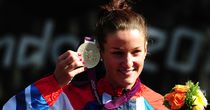
3. Lizzie Armitstead
The silver medal-winning cyclist used her platform to make some serious points about sexism in her sport, and did so in a measured, thoughtful way that ensured she didn't come across as bitter or chippy.
Armitstead also suggested she would like to sit down with the UCI president, Pat McQuaid, to explain her point of view. McQuaid would do well to take her up on the offer.
4. British losers
The British fans love winning, as the reaction to Wednesday's and Thursday's gold medals has demonstrated. But it's not the be-all and end-all, and, conversely, they also love an underdog, especially a British underdog.
They cheered the novice men's and women's Handball teams to the rafters of the Copper Box, even - or especially - as they went down to heavy defeats. Reminiscent of the Tartan Army - even when they're beaten, they're not really beaten.
5. Bert le Clos
The Olympic Games often conjure up great father/son moments. Think of Chris Hoy weeping on his father's chest after his third gold medal in Beijing, or - the most poignant of the lot - Derek Redmond being helped to finish his 400 metres semi-final in Barcelona in 1992.
Bert le Clos had just witnessed his son, Chad, beat Michael Phelps to win gold in the 200m butterfly when he was interviewed by Clare Balding. "Un-believable, unbelievable, unbelievable," he said. Fair to say he was not prepared to be interviewed live on television, which is what gave his appearance its charm.
"Is this now?" he asked at one point. "Yes, it's live," replied Balding, and le Clos recoiled. It was as though he had been cut open: his emotions were spilling out, and he was powerles to stem the flow. "Look at him," he said when he spotted Chad, "he's beautiful, look at this, what a beautiful boy!"
6. Men's artistic gymnastics team
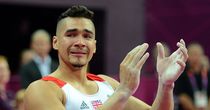
The five members of Britain's bronze medal-winning men's team were compared to a boy band, but their main appeal was that they were nothing like that.
OK, perhaps Louis Smith wouldn't look out of place in such a line-up, but the others were star struck and astonished to find themselves thrust into the limelight. Endearingly, they came across as the most ordinary, down-to-earth young guys imaginable, despite being capable of such magic as we witnessed in the O2 on Monday evening.
7. Valiant effort
Mark Cavendish was deemed to have "failed" to win a gold medal in the road race last Saturday. Even on Wednesday, when the first gold medals landed in British hands, reference was made to the disappointment of his "failure".
Cavendish did not fail. Fact is, a road race is virtually uncontrollable, but that didn't stop the five-man British team from trying to control it. They had no real choice if they wanted a gold medal, because the best chance of winning was a bunch sprint involving Cavendish, the fastest finisher in the world. And the four men did a phenomenal job to try and make it happen, but when Fabian Cancellara and the eventual winner, Alexandre Vinokourov, took off on the final climb of Box Hill, they couldn't respond.
Their tactics were hugely ambitious, the effort was heroic, and the plan almost came off. The fact it didn't does not equate to failure.

MISSES

1. Empty seats
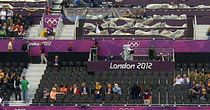
There is no more depressing sight than that of rows of empty seats, and it has been a depressingly common spectacle.
But the most depressing thing of all is that the empty seats do not reflect a lack of interest. Whether it is members of the IOC 'family' or sponsors not turning up, there can't be any excuse.
2. Corporate bullying
Sponsorship is a necessary evil, but does it have to be quite so evil? The likes of Visa, McDonald's and Coca-Cola sponsor the games because they like the association, presumably, and because they think it'll be good for their image and, ultimately, good for business.
So why, then, do they throw their weight around to such an extent that they have a monopoly on the Olympic Park and other venues? Is this really the most effective way to endear yourself to the masses?
3. Wimbledon
The atmosphere at Wimbledon is fine, but it doesn't really feel like the Olympics, and it doesn't really feel like Wimbledon, and falls a little short of both. There is also the fact that it is out on a limb - which can't really be helped, given that it would be difficult to transplant the Wimbledon complex to East London, but some players do not seem overly enamoured by the long daily bus transfers from the athletes' village.
4. Meddling officials
Step forward the governing bodies for badminton and cycling for unnecessary meddling.
The badminton players sent home in disgrace have been treated shabbily while the officials who made the rules they were trying (legally) to exploit in order to give themselves a better chance of winning a medal remain in London, free to take up their allocation of seats (or not).
The serial meddlers at cycling, meanwhile, have conspired to make the track cycling programme about half as good as it could have been, thanks to their new rule of one rider per country per event. The new rules concerning the team sprint - which saw the British and Chinese teams relegated - are also baffling.
5. Ye doping suspicion
On the one hand, it is good that questions are asked of apparently suspicious performances. In the past, too few questions have been asked, with disastrous consequences.
Sadly, however, the inquisition of Ye Shiwen, and the implied accusastions of the American coach John Leonard, carried unpleasant undertones. True, China has a poor record when it comes to doping. So does America.

Impotent A Day that Marked Terror?

I was only ten years old when this terrible day marked history. Too young to understand the way the world had changed that day, I remember spending my day as carefree as ever. It wasn’t until late evening that I actually saw anything on the television.
As years passed by, controversies were unfolded; the blame game was on, and so on. These years were my growing years; my teenage, when I was trying to search for an identity. At the moment of the attacks I had heard the word ‘Terrorism’ for the first time but the following years did not bring a single day that passed without hearing it.

Being a Muslim it really hurts when people accuse Islam of being a religion that promotes terrorism, brutal and when you add a teenager to that equation; sometimes you really lose your calm. I remember thinking a lot on this debate, sometimes loudly, but over the years I have matured and learnt to respect everyone’s opinions whether they are against or for Islam.
Each year on this day I see people mourning for the lives that were lost and sympathizing the damage done. I myself feel really bad for all the lives that were lost and for the people that they have left behind. I am a Muslim but I will never support irrelevant acts carried out in the name of God. But this year for once I want everyone to think also about the effects this event has left on random people all over the world. In particular the Muslims of Pakistan, a country which has been the subject of much hype ever since.

Many people died in those attacks but following years have brought doom for all Muslims. Ever since we frequently hear of bomb blasts in Pakistan claiming innumerable lives with each one. I particularly remember the year 2009, which has been my personal worst in this regard. There was an attack at Gangaram hospital which is not far from my previous university, I remember the sound vividly and also the huge smoke cloud that had formed just above our university ground. I just can’t forget that day and even today I think that if this is how I had felt, what would the people at the blast site must have felt like?

This question that quakes me and honestly I don’t want to know the answer for it. That year was so full of terrorist attacks that the university had to postpone exams several times but the worst thing I remember is the insecurity I had felt for my own and my loved one’s lives in my very own country. I used to say my good byes properly in case I might not return home because that is what used to happen in those days. My question is that why nobody cares for the lives Muslims lose everyday? Aren’t we as important as those that died in those attacks? Aren’t we the victims of the same terrorism? Why people don’t think about these people before they call Muslims terrorists?

Olympic London 2012 Scots enjoy record success

Scotland is celebrating a record haul of Olympic medals at the London Games.
The total stands at 13 with two days of competition remaining, with Mhairi Spence from Inverness tipped for success in Sunday's modern pentathlon.
Track cyclist Sir Chris Hoy contributed two of seven golds for Scotland, with Andy Murray winning the tennis singles.
Katherine Grainger and Heather Stanning won rowing events, while canoeist Tim Baillie and showjumper Scott Brash also landed golds.
Sir Chris's successes in the keirin and men's team sprint make the 36-year-old from Edinburgh Britain's most successful ever Olympian - with a total of six golds and one silver medal.
And Grainger was a hugely popular winner in the double sculls, having picked up three silver medals at previous Games.
Tennis star Murray was also awarded a London silver in the mixed doubles with partner Laura Robson.
Glasgow swimmer Michael Jamieson won a silver 200m breaststroke and David Florence also took silver in the slalom canoeing, while sailor Luke Patience from Rhu finished second in the 470 class.
Daniel Purvis was part of the men's team that came third in gymnastics and Laura Bartlett and Emily Maguire in the Great Britain squad that picked up bronze in the hockey.
Scotland's Olympic medallists

Sir Chris Hoy (track cycling), two golds
Andy Murray (tennis), one gold, one silver
Katherine Grainger (rowing), gold
Heather Stanning (rowing), gold
Scott Brash (team showjumping), gold
Tim Baillie (C2 canoe slalom), gold
David Florence (C2 canoe slalom), silver
Luke Patience (470 sailing), silver
Michael Jamieson (swimming), silver
Daniel Purvis (team gymnastics), bronze
Laura Bartlett & Emily Maguire (team hockey), bronze
The seven gold medals equals the number won by Scots in Stockholm 100 years ago but the overall tally makes it the best-ever performance.
And with Spence the current modern pentathlon world champion that could yet rise, while Lee McConnell and Eilidh Child may run in the 4 x 400m relay team on Saturday evening.
Mike Whittingham, director of high performance at the sportscotland Institute of Sport, said: "The performance of our athletes at the London Olympics has been truly phenomenal.
"It is clear that the Scottish athletes have punched above their weight at London 2012."
There was a record number of 55 Scots in Team GB and the 12 medals doubles the amount won in Beijing four years ago.
The spread of success is also greater, with nine sports yielding podium finishes compared to just three disciplines in 2008, when Sir Chris came back with three golds.
There were a few high-profile disappointments for Scotland in London, with Florence failing to make the final of the slalom canoe C1, before his silver in the C2.
Garioch swimmer Hannah Miley had medal hopes in the 400m individual medley but had to settle for fifth place in the final and experienced judo player Euan Burton crashed out after his first match.http://www.skysports.com

London 2012 Olympics Day 15 most popular moments

Mo Farah has already played his part in one of the greatest nights in British athletics' history at London 2012 and he goes for a second Olympic gold medal on Saturday. Great Britain also have gold medal hopes in the diving pool and in the boxing ring.
Full schedule available on BBC Sport website
ATHLETICS (19:30 BST): Mo Farah, men's 5,000m
Farah won the 10,000m in scintillating style last Saturday and, as the 5,000m world champion, he could well repeat the feat a week later as he goes for an Olympic double. His American training partner Galen Rupp, who took silver in the 10,000m, and Bernard Lagat of the United States will be among the main threats.


The London 2012 athletics programme could end on a high when Usain Bolt leads Jamaica's defence of their 4x100m relay title (21:00).
DIVING (20:25): Tom Daley, men's 10m individual platform
Daley will have to improve considerably on his qualifying performance if he is to make it through the semi-finals (10:00) to Saturday evening's final. The 2009 world champion was in danger of an early exit on Friday but scraped through in 15th place out of 18 qualifiers. China's Qiu Bo and Lin Yue and defending Olympic champion Matthew Mitcham of Australia will be among those battling for medals.

Read up on the protagonists:

Medals would be for Daley's dad
Joshua dares to dream
London 2012 day-by-day guide
Full BBC coverage schedule
11 August BBC TV & radio Olympic schedule
BOXING (20:45): Luke Campbell v John Joe Nevin, men's bantamweight
The crowd will be something to behold at the ExCel Arena when Britain's Luke Campbell takes on John Joe Nevin of Ireland in the bantamweight (56kg) final. Both teams already have one boxing gold each, through Nicola Adams and Katie Taylor, and the atmosphere for each final was a match for any professional fight. Campbell and Nevin have met twice before, with one win apiece.
CANOE SPRINT (09:37): Ed McKeever, men's K1 200m
Trainee accountant McKeever qualified in fine style for the final and has every chance of taking over from Tim Brabants as a British canoe sprint Olympic champion. Canada's Mark De Jonge was the only man faster in the semi-finals. Britain's Liam Heath and Jon Schofield made it through to the final of the men's K2 and are confident they can win a medal (10:48).
HOCKEY (15:30-16:55): Great Britain v Australia men
Great Britain's men suffered a humbling 9-2 defeat in their semi-final against the Netherlands, but world number one side Australia will have been equally disappointed to have lost to Germany when many tipped them for gold. Britain and Australia met in the group stage in one of the matches of the tournament, the home side coming back from three down to draw 3-3.
MOUNTAIN BIKE (12:30-14:00): Annie Last
The Hadleigh Farm course will finally become an Olympic stage as the mountain bike cross-country begins with the women's event. Last will be the first British woman to take part in the event since the 2000 Sydney Games.
MODERN PENTATHLON (08:45-19:05): Nick Woodbridge
Woodbridge, the world number nine, won bronze at the Olympic test event last year and lines up for Britain along with Sam Weale. The five events will take place across three venues - the Copperbox, the Aquatics Centre and Greenwich Park.http://www.bbc.co.uk